Dame Washalot–Old Woman Who Lived in a Shoe friendship
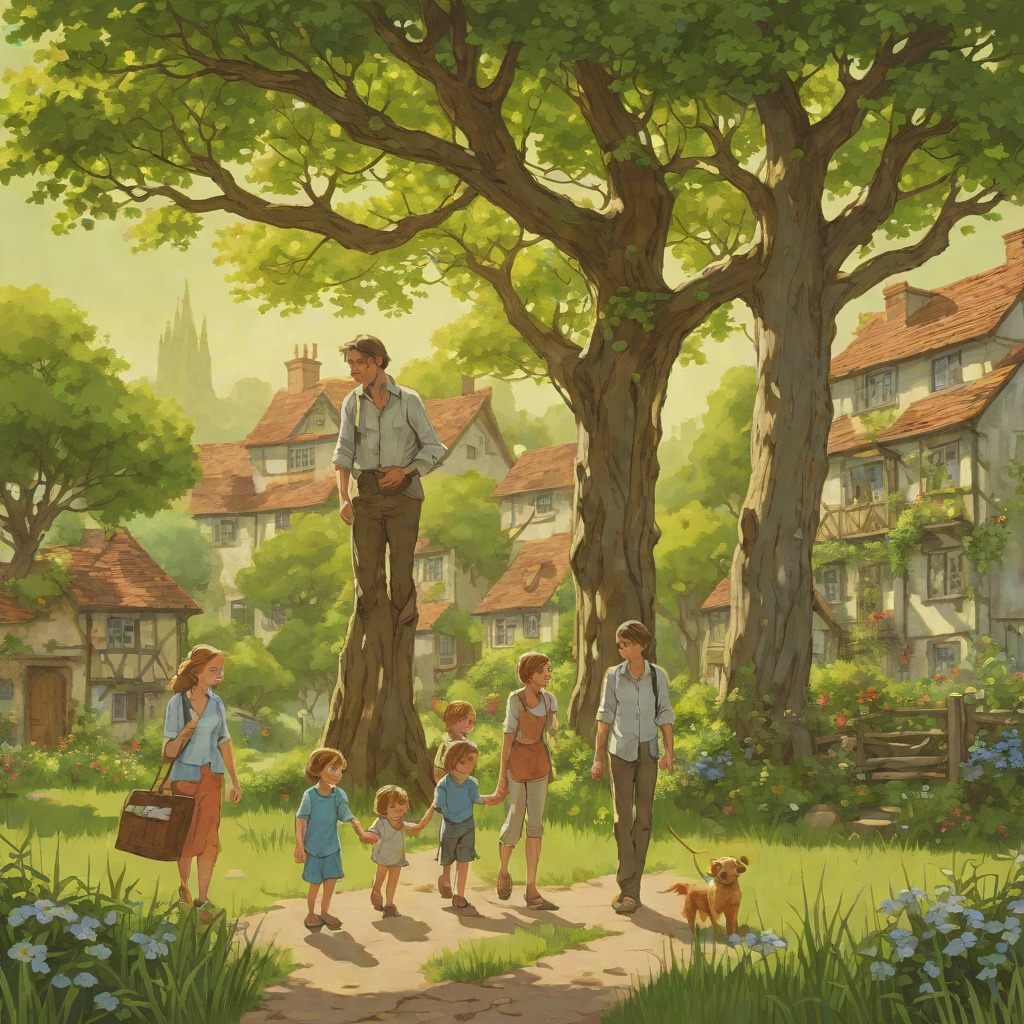
The Faraway TreeThe Dame Washalot–Old Woman Who Lived in a Shoe friendship is a long-standing personal connection that links two inhabitants of the Faraway Tree’s changing lands. Its decisive significance is practical rather than sentimental: because Dame Washalot is described as an old friend of the Old Woman Who Lived in a Shoe, the Old Woman feels entitled to move into Moon-Face’s vacant house, turning friendship into the social bridge through which an invasion of private space occurs.
Friendship as a Social Connection
The friendship is revealed when Silky urgently summons Moon-Face and the Saucepan Man back to the Faraway Tree. The Old Woman Who Lived in a Shoe’s land has risen to the top of the tree, and she has climbed down through the cloud to visit Dame Washalot. The visit is not presented as a chance encounter: Dame Washalot is explicitly called an old friend, implying a relationship that predates the immediate crisis and is familiar enough to motivate a personal call.
The episode places the friendship within the Faraway Tree’s unstable vertical geography. Lands shift to the treetop, visitors descend through a hole in a cloud, and domestic relationships can therefore produce consequences across radically different spaces. Dame Washalot’s connection with the Old Woman Who Lived in a Shoe gives the visitor access to the tree and, indirectly, to knowledge of Moon-Face’s home. A private association becomes part of the tree’s circulation system, carrying one resident from her own land into another character’s household.
The Friendship and Moon-Face’s Empty House
When the Old Woman Who Lived in a Shoe sees that Moon-Face’s house is empty, she announces that she will live there. Her justification combines dissatisfaction with her former home and confidence in her connection with Dame Washalot. She says that she is tired of looking after a pack of naughty children, no longer wants to live in a shoe, and intends to live by herself; she adds that Dame Washalot is an old friend with whom she can talk about old times. The friendship thus functions as an argument of belonging. It makes the new occupation seem, to the Old Woman, socially supported rather than merely opportunistic.
The same claim exposes the relationship’s uneven consequences. Nothing in the evidence indicates that Dame Washalot invited the Old Woman to take Moon-Face’s house or approved the seizure. Yet the Old Woman invokes their friendship while acting unilaterally. The bond therefore operates as a form of assumed permission: familiarity with Dame Washalot is treated as if it could authorize possession of a home belonging to Moon-Face.
Contrast Between Companionship and Conduct
The Old Woman’s stated desire for pleasant companionship contrasts sharply with her treatment of the house and its rightful owner. She imagines living independently and having a good time with Dame Washalot, but she also slams the door in the faces of Moon-Face, Silky, and the children. Her conduct converts a potentially sociable reunion into exclusion. The friendship is associated with conversation and old memories on one side, but with the denial of another person’s claim on the other.
Her domestic behavior reinforces this contradiction. After occupying the house, she nails up the Slippery-Slip and places Moon-Face’s bed across the board, blocking the route through the tree. The friendship with Dame Washalot is therefore embedded in a conflict over movement, shelter, and control. The Old Woman wants a private life, but obtains it by making Moon-Face’s home inaccessible and by turning a shared route into a barrier.
Narrative Function and Limits
As a relation, this friendship is significant because it explains how the Old Woman Who Lived in a Shoe reaches Moon-Face’s house and why she treats the occupation as defensible. It also illustrates the wider instability of the Faraway Tree, where shifting lands create encounters that ordinary geography would keep apart. The visit begins with an old social tie, but its immediate narrative result is not reconciliation: it produces a territorial dispute and forces Moon-Face and his friends to seek a way to reclaim the house.
The evidence gives the friendship a clear existence and a concrete consequence, but does not show a direct exchange between Dame Washalot and the Old Woman beyond the visit and the Old Woman’s reference to their history. The relationship is consequently defined through reported action and its effects on others. Its narrative power lies precisely in that indirectness: an old friendship, mentioned as background, becomes the unseen support behind a sudden change in ownership and the disruption of Moon-Face’s home.